
ATLANTA,GA
DULUTH, GA
Many lawyers lack experience in bringing claims against the United States government for injuries or deaths caused by U.S. government employees, and they contact our firm because of our experience in those cases. We have summarized below some points that are essential to know:
Filing claims against the United States.
The federal government is generally immune from civil suit for negligent acts by government employees, based on the doctrine of “sovereign immunity.” . Thankfully, Congress has waived that sovereign immunity to allow certain cases to be filed against the United States under the Federal Tort Claims Act (28 U.S.C. § 1346(b) and § 2671-2680). The Federal Tort Claims Act (FTCA) makes clear that if a private business or individual could be held liable for damages for injuries to a third party, typically so can the federal government for the acts of its employees.
The FTCA allows persons to recover money from the government for damages, loss of property, personal injury, or death. To be successful, the injured person must show that the damages resulted from the negligent or wrongful acts of government employees acting within the scope of their employment, under circumstances where the United States, if a private person, would be liable to the claimant in accordance with the law of the place where the act or omission occurred. 28 U.S.C. §§ 1346(b), 2674.
Under the FTCA, the federal government acts as a self-insurer, and it recognizes liability for the negligent or wrongful acts or omissions of its employees acting within the scope of their official duties. The United States is liable to the same extent an individual would be in like circumstances.
There are limits to the governments’ waiver of its sovereign immunity, however. But if an individual is injured or killed by the negligent acts of a federal employee, there may be an avenue of recovery under the FTCA. In some cases, the only avenue of recovery is compliance with the provisions of the FTCA, which contains several hidden traps for the unwary.
How does someone assert a claim under the FTCA?
The FTCA, because it is a waiver of sovereign immunity, has several specific provisions that require specific adherence; otherwise, there is no claim to be asserted. Here we refer to a required “Ante Litem” Notice that must be filed with the United States government. One can look online and find a Notice of Claim Form 95, which is used to notify the government of the alleged wrongful act(s).
If a client is injured by a federal vehicle or a federal employee in some way, and if the federal employee was on the job working for the United States government, an FTCA claim must be asserted against the United States via an Ante Litem Notice through a Form 95. That claim form basically provides information to the government agency involved regarding the claim: the date of the act, the type of injuries suffered, and the parties involved. Under the applicable rules, one must describe in detail the nature and extent of the damages and must claim a specific sum in monetary damages. Each claimant, for example a husband and wife who might be injured in a single collision, must file separate forms.
What happens after a claim is filed?
Once the Form 95 is filed with the appropriate federal agency, a claimant must wait for six months or until the claim is denied, whichever is earlier, before a lawsuit can be filed. See 28 U.S.C. § 2675(a). If a claim is denied or six months expires without any action by the federal agency, suit must be filed where the Plaintiff resides or where the act or omission complained of occurred. Once suit is filed, only the United States of America can be named as a Defendant–not the agency and not the negligent employee.
How long does someone have to assert the required Ante Litem Notice/Form 95 under the Federal Tort Claims Act?
The statute of limitations for the Federal Tort Claims Act, 28 U.S.C. § 2401(b), basically provides that the statute expires two years after a claim accrues, unless the action is brought within six months after the date of the mailing of a final denial of a claim. In short, if an agency does not act on a claim that is timely submitted, the statute of limitations is tolled until the agency issues its final ruling. In some states where the statute of limitations is longer than two years, there could be an extension to file the Ante Litem Notice.
Are there jury trials under the Federal Tort Claims Act?
No. Many practitioners do not realize that there is no right to a jury trial in a Federal Tort Claims Act case. In such a case, a United States District Court Judge sits as a judge of the facts and the law. Damages in a particular case are to be governed by the law of the place where the act or omission occurred and are limited to compensatory damages only.
Am I able to sue the United States government for any claim whatsoever under the Federal Tort Claims Act?
The answer again is no. The government is immune from civil suits unless the government has consented to be sued. The Federal Tort Claims Act is a limited and specific waiver of the government’s sovereign immunity for the negligent act of government employees. If a mail truck driver runs a stop sign and injures a family, the United States is liable, and the claim can be submitted to the U.S. Postal Service for the possibility of pre-suit settlement via the Form 95. Again, an Ante Litem Notice (Form 95) must be submitted to the Postal Service. If after the claim has been submitted it is not successfully resolved, only the United States can be named as a party thereafter.
How do you bring medical malpractice claims against the federal government?
Medical malpractice or medical negligence claims are already complex, and bringing those claims against the federal government requires special care and knowledge. Here is a sampling of what our lawyers at Finch McCranie have learned in bringing these cases:
Identifying providers covered under the FTCA
As an initial matter, in some circumstances it can be difficult to determine whether a provider may be deemed as an employee of the Public Health Service for purposes of Federal Tort Claims Act (FTCA) coverage for the performance of medical, surgical, dental, and related functions within the scope of employment. The Health Center FTCA Program increases the availability of funds to health centers to provide services within the Health Center Program scope of project by reducing or eliminating health centers spending on malpractice insurance premiums. These facilities are required to disclose that they are covered under the FTCA on their website, but the notice is typically difficult to find and oftentimes buried in a subpage on their website.
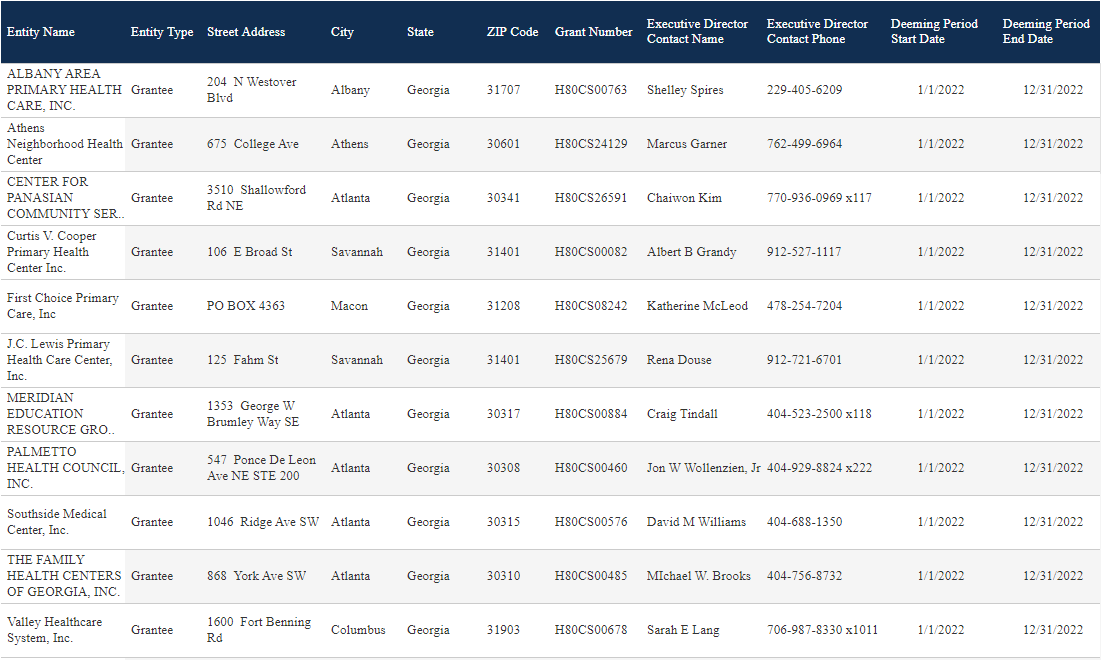
Below is a listing of recipients of Health Center Program grant funding that have been deemed as PHS employees and therefore covered under the provisions of the FTCA in Atlanta, Albany, Athens, Macon, and Savannah. The complete database can be accessed at data.hrsa.gov/tools/ftca-search-tool.
Prerequisite to Suit
As a key condition that the United States has imposed under the Federal Tort Claims Act, the plaintiff must present an administrative claim (Form 95) to the responsible federal agency prior to the initiation of the suit. In the context of a medical malpractice case, the “responsible agency” will typically be Veterans Affairs or the Department of Health and Human Services (“HHS”). The relevant statute is 28 U.S.C. § 2675(a) which provides in part:
(a)An action shall not be instituted upon a claim against the United States for money damages for injury or loss of property or personal injury or death caused by the negligent or wrongful act or omission of any employee of the Government while acting within the scope of his office or employment, unless the claimant shall have first presented the claim to the appropriate Federal agency and his claim shall have been finally denied by the agency in writing and sent by certified or registered mail. The failure of an agency to make final disposition of a claim within six months after it is filed shall, at the option of the claimant any time thereafter, be deemed a final denial of the claim for purposes of this section. The provisions of this subsection shall not apply to such claims as may be asserted under the Federal Rules of Civil Procedure by third party complaint, cross-claim, or counterclaim.
Time for Filing
– Administrative Claim
The administrative claim must be timely filed, or it will be barred by the statute of limitations. 28 U.S.C. § 2401(b) provides that “[a] tort claim against the United States shall be forever barred unless it is presented in writing to the appropriate Federal agency within two years after such claim accrues or unless action is begun within six months after the date of mailing, by certified or registered mail, notice of final denial of the claim by the agency to which it was presented.”
– Rejection Period
The plaintiff must wait to file suit until the agency rejects the claim, or if six months pass without the agency’s rejection, this may be treated as a denial. 28 U.S.C. § 2675(a). If a lawsuit is begun before the filing of an administrative claim, or before the rejection period has expired of the claim denied, the suit is subject to dismissal.
Substantiation of a Claim
Many courts have held that providing insufficient information to allow an agency to process a claim is tantamount to failure to file a proper claim. These courts have dismissed the subsequent lawsuit for lack of jurisdiction. Rothman v. United States, 434 F. Supp. 13 (C.D. Cal. 1977) and Kornbluth v. Savannah, 398 F. Supp. 1266 (E.D. N.Y. 1975). The rationale for this position was simply stated in Kornbluth:
The purpose of requiring preliminary administrative presentation of a claim is to permit a government agency to evaluate and settle the claim at an early stage,… These purposes would be defeated if a claimant could refuse to submit the information necessary for the agency to evaluate the claim and then present the matter for the first time to a district court. (398 F. Supp. 1268).
In each of these cases, the court relied upon agency regulations requiring designated information to be supplied in support of a claim. (Department of Justice, 28 C.F.R. § 14.4; Postal Service, 39 C.F.R. § 912.7(b); and Veterans Administration, 38 C.F.R. § 14.607.)
Form 95 is fairly straightforward. It requires the practitioner to provide identifying information concerning the client, the injuries at issue, and a brief description of the alleged negligence. You must provide enough information for the responsible agency to properly evaluate the claim. In a medical malpractice case, this will involve submitting certified copies of the client’s medical and billing records related to the malpractice at issue, and records pertaining to any treatment incurred as a result of the malpractice. Since claims are almost always denied at the administrative stage, you can be virtually certain you will need to file a lawsuit.
With a lawsuit necessary, it is good practice to obtain an expert affidavit (e.g., under O.C.G.A. 9-11-9.1), setting forth the relevant standard of care violation(s) and any issues concerning causation, and to submit the affidavit with your Form 95. It is also advisable to provide comprehensive information supporting your damages claim as well. This process often involves submitting before-and-after photos/video, a Day-in-the-Life video, Life Care Plan, and similar materials supporting the damages claim.
The FTCA also requires a claimant to demand provide a “sum certain”–the “Total Amount of Claim” in the Form 95. In other words, you must clearly convey the total amount of your demand. If and when the case goes into litigation, a claimant cannot recover more than the amount demanded in the Form 95 “except where the increased amount is based upon newly discovered evidence not reasonably discoverable at the time of presenting the claim to the federal agency.” 28 U.S.C. § 2675(b).
The filing of an administrative claim is a jurisdictional requirement, and it is an absolute prerequisite to maintaining a civil action against the government for tort damages arising from the negligence of a federal employee. Some agencies have their own regulations governing the filing of administrative claims, but in most cases, they are virtually identical to the regulations issued by the Department of Justice, 28 C.F.R., Part 14.
– Lawsuit
Once the agency’s six-month rejection period has expired, suit must be brought within a subsequent six-month interval. Or if the agency actively rejects the claim, an action must be commenced within six months of the date of the agency’s rejection letter. If a suit is brought more than six months after the agency’s denial of the claim, it will be barred by the statute of limitations.
If a suit is filed during the first six months after the administrative claim is filed, such an action will be dismissed by the court for lack of jurisdiction, although the dismissal may be without prejudice to refiling once there has been compliance with the statute. A court may not hold a case in abeyance while a claim is presented to the agency, because “where a court lacks jurisdiction, it cannot retain jurisdiction.” Fuller v. Daniel, 438 F. Supp. 929 (N.D. Ala. 1977).
Parties to a Claim
The regulations also define who may file an administrative claim. 28 C.F.R. § 14.3(b). A claim may be presented by the executor or administrator of the decedent’s estate or any person legally entitled to assert such a claim in accordance with applicable state law. In the event a claimant is not competent to bring suit in their personal capacity, a duly appointed conservator can file the Form 95 and bring suit on that person’s behalf.
When the government is sued under the Federal Tort Claims Act, the complaint should name the United States of America as the defendant, and not the federal agency. The action may only be brought in a United States District Court, not in a state court. It must also be brought in the federal judicial district where the plaintiff resides or where the negligent act or omission occurred.
Basically, a suit against the United States is similar to a suit against a private person. The discovery process is the same, pursuant to the Federal Rules of Civil Procedure. However, a few differences exist. Again, the amount of monetary damages asserted in the administrative claim and in the complaint must be for a “sum certain,” a definite amount. In Raymond v. United States, 445 F. Supp. 740 (E.D. Mich. 1978), the amount of damages stated in the claim was “in excess of $50,000.00.” The court dismissed the case for failure to state a “sum certain.”
Damages are limited to the amount asserted in the administrative claim, unless an increased amount is based upon newly discovered evidence that was not reasonably discoverable at the time of presenting the claim to the federal agency, or upon allegation and proof of intervening facts. 28 U.S.C. § 2675(b); Kielwein v. United States, 540 F.2d 676 (4th Cir. 1976), cert. denied 429 U.S. 979 (1976).
The FTCA expressly provides that claims against the government “shall be tried by the Court without a jury.” 28 U.S.C. § 2402. However, several courts have held that an advisory jury is permissible as “an optional aid to an independent court, not the factfinder or decision-maker.” Hamm v. Nasatka Barriers, Inc., 166 F.R.D. 1 (1996). Especially where other parties are joined as defendants with the United States, the judge may consider an “advisory jury” insofar as the government is concerned, although the court makes the final decision about whether or not the United States is liable.
Finally, it should be remembered that the liability of the United States is determined in accordance with the law of the place where the negligent act or omission occurred, which means the whole law of the state is applied, including its conflicts of law principles. Richard v. United States, 369 U.S. 1 (1962). In short, experience in handling medical malpractice lawsuits in state courts is helpful in handling an FTCA medical malpractice case in federal court, provided that counsel complies with all of the various requirements described above.
The FTCA, 28 U.S.C. § 1346(b), states that damages will be measured by the law of the state in which the tort occurred.
Wrongful Death
Wrongful death claims constitute the majority of Federal Tort Claims Act cases. The type and amount of damages recoverable, as stated previously, depend upon the law of the state where the act or omission occurred. Many factors are considered by the courts in assessing damages: age, health, and marital status of the decedent, future lost wages, deduction for personal consumption, number and ages of minor children, loss to the estate, loss of consortium, remarriage of spouse, set-off for Social Security benefits, the effect of federal and state income taxes upon the future earnings of plaintiff’s decedent, and the impact of inflation.
Punitive Damages
Punitive damages are not allowed against the United States under the Federal Tort Claims Act. 28 U.S.C. § 2674.
Attorneys’ Fees and Other Costs
Attorney fees in FTCA cases are controlled by statute. Under 28 U.S.C. § 2678, attorneys may not charge a contingency fee of more than 20% of the gross recovery if the claim is resolved before a lawsuit is filed. If suit is filed, the attorney fee may increase to a maximum of 25% of the gross recovery regardless of whether the recovery results from a judgment or pretrial settlement. The attorneys’ fees are payable from, not in addition to, the amount of the recovery. The attorneys’ fees do not include costs such as docket fees, payments to expert witnesses, etc.
In some circumstances, an attorney may sign up a client prior to discovering the case is governed under the FTCA. In such cases, the practitioner should immediately prepare a new representation agreement that is consistent with the fee schedule set forth in 28 U.S.C. § 2678 and have the client sign that agreement.
The attorneys at Finch McCranie have handled numerous Federal Tort Claims Act cases over the years. Those cases include medical malpractice claims concerning the Veterans Administration and other federal clinics, claims against the United States Postal Service, claims against the FBI for drunk driving by an FBI agent on the job, and other claims.We have also tried and won cases tried to U.S. District Court Judges.
Everyone should know that these nuances of the FTCA are procedural traps for any lawyer unfamiliar with the FTCA. Clients are well advised to seek counsel experienced in this area when dealing with a potential claim against the United States government.
Given the unusual features of the FTCA, if you or a loved one have suffered a catastrophic injury or otherwise been damaged by the act of a federal employee, you should consult with an experienced and knowledgeable attorney concerning your rights under the FTCA. For a free consultation, call our attorneys at Finch McCranie, LLP at (404) 793-1066.
We understand the uncertainty that comes with legal issues. Our attorneys are here to guide you every step of the way — from the first consultation to courtroom resolution (if that becomes necessary). We offer confidential, no-obligation case evaluations.
📞 Call us today at (404) 341-5356 or email finchmccranie@finchmccranie.com to schedule your consultation.