
A truck accident lawyer regularly deals with insurance companies that cover large commercial trucks.
This does not mean the lawyer has personal connections with these companies or can promise a larger payment.
It means the lawyer understands how trucking insurance claims work, what questions to ask, and which documents to review.
The lawyer can identify the companies involved in the crash and determine which insurance policies may apply.
They can request policy information, communicate with insurance adjusters, preserve important evidence, and review settlement offers.
This support may help you avoid contacting the wrong insurer, providing unclear information, or signing documents you do not fullyUnderstanding the Complexity of Trucking Insurance Claims.
What Is Commercial Trucking Insurance and How Does It Work?
Commercial trucking insurance is coverage designed to protect truck drivers, trucking companies, and other insured businesses from certain financial losses connected to commercial truck operations.
If a truck driver causes an accident while working, the insurance company investigates the claim.
It reviews the policy, accident report, vehicle records, medical documents, and other available evidence.
The insurer then determines whether the policy covers the accident and what amount may be payable for proven losses.
A commercial trucking policy may include different types of coverage, such as:
- Liability coverage: May pay for another person’s injuries or property damage when the insured party is legally responsible.
- Physical damage coverage: Helps cover damage to the insured truck or trailer.
- Cargo coverage: May cover loss of or damage to goods being transported.
- Uninsured or underinsured motorist coverage: May apply when another responsible driver has no insurance or insufficient coverage.
- General liability coverage: May cover certain business-related incidents that do not arise directly from operating the truck.
A single accident may involve several policies because the tractor, trailer, cargo, and trucking operation may belong to different businesses.
For example, one company might own the truck, another might employ the driver, and a third might load the cargo.
Finding an insurance policy does not mean the insurer will automatically pay a claim.
The company must first decide whether the policy was active, whether it covers the people and vehicles involved, who may be responsible, and whether the claimed losses are supported by evidence.
Policy limits also represent the most the insurer may pay under specific coverage, not a guaranteed settlement amount.
Why Are Commercial Truck Insurance Claims So Complicated?
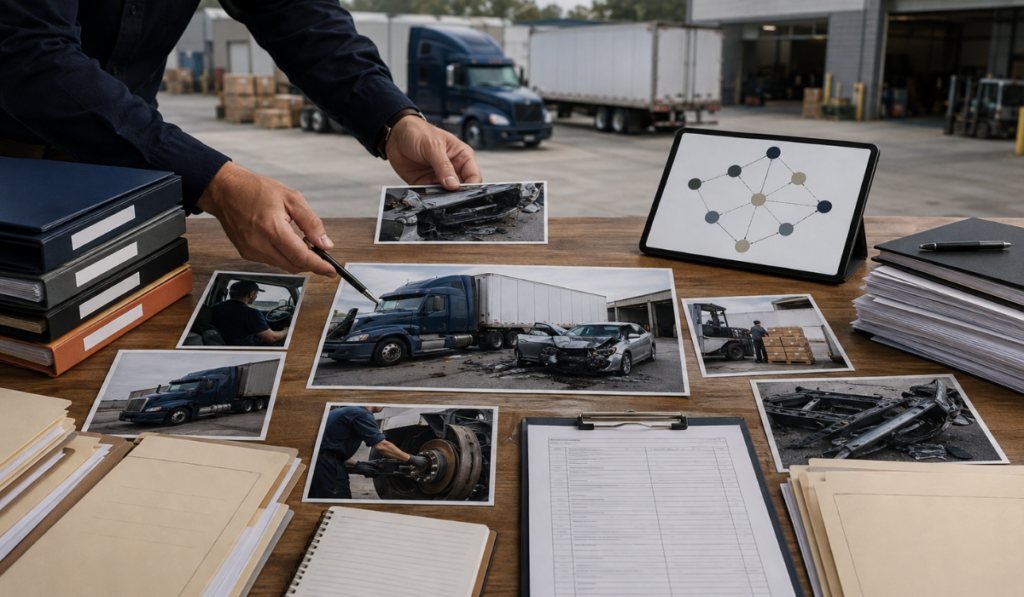
A crash between two cars often involves two drivers and their insurance companies. A commercial truck accident may involve several people, businesses, and policies.
Depending on what happened, the parties could include:
- The truck driver
- The trucking company
- The tractor owner
- The trailer owner
- A company leasing the truck
- A truck maintenance business
- A cargo-loading company
- A vehicle or parts manufacturer
A “party” simply means a person or business that may have some legal responsibility for the crash.
For example, the driver may have made an unsafe turn. However, worn brakes may also have made it difficult to stop. In that situation, investigators may need to examine the driver’s actions, the trucking company’s safety practices, and the maintenance work performed on the truck.
Not every truck accident involves all these parties. The facts and evidence must show who may be responsible.
How May the Trucking Company’s Insurer Handle the Claim?
An insurance adjuster may contact the injured person shortly after the collision. An adjuster is the person who reviews the claim for the insurance company.
The adjuster may ask questions about the crash, injuries, medical history, work, and vehicle damage. The insurer may also:
- Request a recorded statement
- Ask for medical records
- Send a medical authorization form
- Request proof of missed work
- Examine whether another party caused the crash
- Question whether treatment is related to the collision
- Make an early settlement offer
These actions do not automatically mean that the insurer is behaving unfairly. The insurance company has a duty to examine the claim. It also has a financial interest in limiting what it pays.
This difference in goals matters. The injured person wants enough support for proven losses. The adjuster evaluates what the insurer may legally owe under its policy.
A truck accident lawyer can handle these conversations and help the injured person avoid guessing, giving incomplete information, or signing something without understanding it.
How Can a Truck Accident Lawyer Help With the Insurance Process?
A truck accident lawyer does more than make telephone calls. The lawyer must understand the crash, locate the evidence, identify possible coverage, and clearly explain the claimed losses.
Building a Map of the Businesses and Insurance Policies
The first job is to learn who was connected to the truck.
A lawyer may review:
- Carrier registration information
- Vehicle ownership records
- Insurance documents
- Driver employment information
- Leasing agreements
- Cargo and shipping records
- Maintenance contracts
This information creates a map of the people, companies, and policies that may be involved. Without that map, an injured person may send a claim to only one insurer and overlook another possible source of coverage.
Keeping Insurance Conversations Clear
Insurance questions may sound simple but require careful answers.
For example, an adjuster may ask, “How are you feeling?” The person might answer, “I’m okay,” simply to be polite. The insurer could later compare that response with a report of pain.
A lawyer can communicate with the adjusters and provide properly supported information. Legal help may also reduce the chance of:
- Guessing about how the crash happened
- Giving inconsistent answers
- Signing an overly broad authorization
- Accepting an offer without understanding it
The injured person may still have duties under their own insurance policy. The correct response can depend on who is asking, what is requested, and which policy applies.
Asking That Important Evidence Be Saved
Some truck accident evidence may not remain available forever.
Potential evidence may include:
- Electronic logging device records
- Event data recorder information
- Dash-camera footage
- Nearby surveillance video
- Driver qualification records
- Dispatch messages
- Inspection reports
- Maintenance documents
- Cargo-loading records
- Hours-of-service information
An electronic logging device, or ELD, records certain information about a driver’s working and driving time. Federal rules generally require motor carriers to keep ELD records and supporting documents for six months.
Not every truck has the same devices or information. Different records may also have different retention periods. A lawyer may send a preservation letter asking the relevant parties to keep identified evidence.
Showing the Full Effect of the Injuries
An insurance claim needs proof. Saying that an injury caused financial difficulty may not be enough.
Depending on the case, a lawyer may collect:
- Medical records and bills
- Prescription costs
- Rehabilitation records
- Wage statements
- Tax or employment documents
- Information about missed work
- Medical opinions about future care
- Evidence of reduced earning ability
Not every person can claim every type of loss. The available compensation depends on the injuries, evidence, insurance coverage, and law.
A lawyer can organize the records so the insurer can see how the amount being requested was calculated.
Checking an Offer Before the Claim Is Closed
An insurance company may offer a settlement before medical treatment is complete.
A settlement is an agreement to end a legal claim in return for payment. It usually requires the injured person to sign a release. A release is a document giving up certain rights to bring further claims against the people or businesses named in it.
A quick offer is not automatically unfair. However, it should be reviewed carefully.
The injured person may not yet know:
- Whether more treatment will be needed
- How long recovery will take
- Whether the injury will affect future work
- Whether another insurance policy applies
- Which people or businesses the release covers
A truck accident lawyer can compare the offer with the available evidence and explain what rights would end after the release is signed.
Preparing for Negotiation or a Lawsuit
Once the evidence and losses are organized, a lawyer can present the claim to the correct insurers.
The lawyer may explain:
- How the collision occurred
- Who may be legally responsible
- Which evidence supports the claim
- How the injuries affected the client
- How the requested amount was calculated
The insurer may accept, reject, or negotiate the demand. If the disagreement cannot be resolved, the lawyer may recommend filing a lawsuit.
Some claims settle without a trial. Others require court action. Hiring a lawyer does not guarantee a particular result.
When Should You Contact a Truck Accident Lawyer?
Early legal guidance may be helpful if you suffered serious injuries, responsibility is disputed, multiple companies or insurers are involved, an adjuster requests a recorded statement, or you receive a quick settlement offer.
A lawyer can also help when important electronic records or video may need to be preserved or when insurance policies and release documents are difficult to understand.
If you were involved in a commercial truck accident in Atlanta or Duluth, Finch McCranie LLP can review the circumstances of your claim, explain potential insurance issues, and discuss the legal options that may be available. You do not need to understand every insurance rule before seeking guidance.
Frequently Asked Questions
Can several insurance companies be involved in one truck accident claim?
Yes, different policies may cover the driver, motor carrier, tractor, trailer, cargo business, or another responsible company. Whether a policy applies depends on the facts and its terms.
Should I give the trucking insurer a recorded statement?
Be careful before giving one. Your duties may depend on which insurer is asking and which policy applies. Consider getting legal advice before providing a detailed recorded account.
What if the insurer offers a quick settlement?
Read the offer and release carefully. Make sure you understand your injuries, expenses, possible future needs, and the rights you would give up. Signing a release generally closes the covered claim against the released parties.
Should I sign a medical authorization from an insurance company?
Review the authorization carefully before signing it. Find out what medical records it allows the insurer to obtain and how far back the authorization reaches. Consider getting legal advice if you are unsure about its scope.