
A Truck accident lawyer in Atlanta searches often begin when an injured person realizes that a collision involving a commercial vehicle is different from an ordinary car accident.
A truck crash may involve a professional driver, a transportation company, several insurance policies, federal safety requirements, and business records that are unavailable to the public.
These cases may also require substantial investigation. Driver logs, vehicle data, maintenance records, cargo documents, dispatch communications, and delivery schedules can all become important.
Some records may be retained for only a limited period, making early action especially important.
Finch McCranie LLP helps injured people understand these challenges and examine their available legal options.
Although no lawyer can guarantee a particular result, certain qualities can help you identify an Atlanta truck accident lawyer who is properly prepared for your case.
Why Atlanta Truck Accident Lawyers Are Different From Other Injury Lawyers
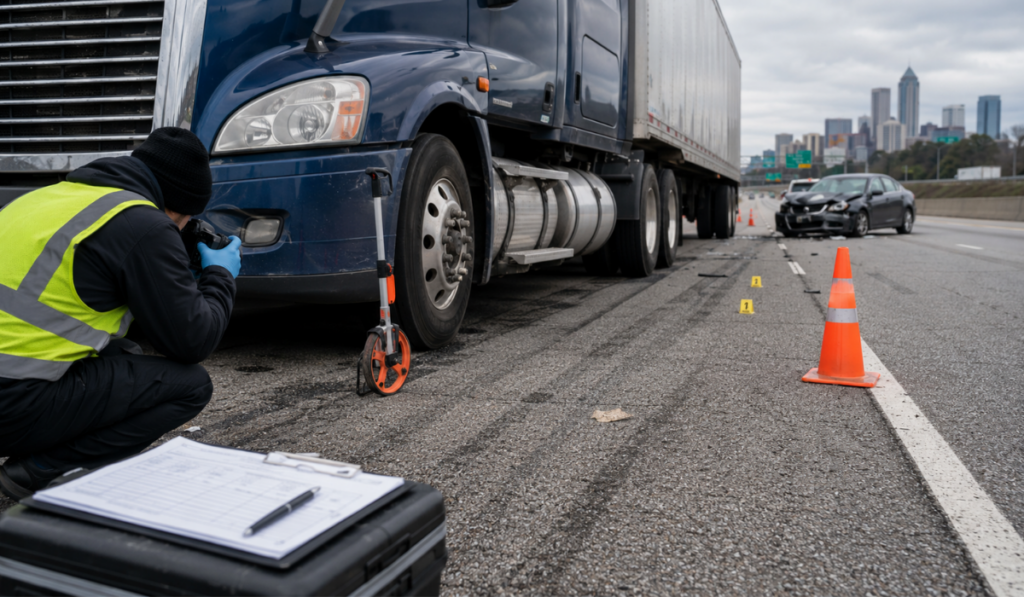
A lawyer who handles ordinary automobile claims may understand Georgia negligence and insurance law.
However, commercial truck accidents introduce additional legal and factual questions.
The lawyer may need to determine:
- Whether federal motor carrier regulations applied
- Who owned and operated the vehicle
- Whether the driver was an employee or contractor
- Who inspected and maintained the truck
- Whether the driver exceeded permitted working hours
- Whether a delivery schedule created unsafe pressure
- Whether improperly loaded cargo affected the vehicle
- Which companies and insurance policies may be involved
Truck accident lawyers must know how to investigate the entire commercial operation rather than focusing only on the driver’s actions at the moment of impact.
They should also be prepared to work with accident reconstructionists, engineers, medical professionals, vocational experts, and economists when the case requires specialized analysis.
That combination of legal knowledge, investigation, and case management helps distinguish truck accident representation from routine automobile claim handling.
Factors That Can Make an Atlanta Truck Accident Lawyer the Best Fit for Your Case
Searching for the best Atlanta lawyer for delivery truck accidents does not produce one answer that applies to everyone.
The right choice depends on the type of vehicle involved, the disputed issues, the severity of the injuries, and the lawyer’s ability to handle those particular circumstances.
The following factors can help you evaluate whether a lawyer is suitable for your claim.
Experience With Commercial Truck Operations
Commercial vehicles include more than tractor-trailers. Atlanta roads also carry box trucks, dump trucks, construction vehicles, cargo vans, moving trucks, and local delivery vehicles.
Each operation presents different questions. A long-haul carrier may be subject to hours-of-service and electronic logging requirements.
A local delivery driver may qualify for exceptions from certain federal requirements. A rented or leased truck can create questions about ownership, maintenance, and insurance coverage.
A qualified lawyer should not assume that every truck is regulated in the same way. The lawyer should first identify:
- The vehicle’s size and weight
- The type of cargo being transported
- Whether the trip involved interstate commerce
- The driver’s employment arrangement
- The businesses controlling the vehicle
- The safety rules applicable to the operation
Finch McCranie LLP can evaluate these details before deciding which legal requirements and records may affect the claim.
Knowledge of Delivery Truck Accident Issues
Delivery drivers often work under conditions that are different from those faced by long-haul truck drivers.
They may make frequent stops, enter residential areas, reverse into narrow spaces, park near intersections, and move between traffic and loading areas throughout the day.
A delivery truck investigation may examine whether:
- The route allowed enough time for safe completion
- The driver was distracted by a phone or navigation device
- Performance expectations encouraged speeding
- The driver received sufficient training
- The vehicle had unresolved mechanical problems
- Packages or cargo blocked the driver’s view
- The truck was parked or reversed unsafely
- The company ignored previous safety concerns
Employment arrangements may complicate the claim. A driver might work for a delivery brand, regional contractor, fleet operator, or staffing company.
The name displayed on the truck may not identify every business involved.
A lawyer should review contracts, dispatch instructions, payroll information, route data, and the company’s control over the driver instead of automatically accepting an independent-contractor label.
Ability to Preserve Time-Sensitive Evidence
The evidence required to understand a truck collision may be controlled by the trucking company, delivery business, maintenance provider, or another commercial party.
Relevant material may include:
- Electronic logging device records
- Event data recorder information
- GPS and telematics data
- Dispatch communications
- Driver qualification files
- Inspection and repair histories
- Delivery manifests
- Bills of lading
- Cargo loading records
- Driver schedules
- In-cab camera footage
- Mobile phone records
- Post-accident vehicle inspections
Federal regulations require covered carriers to retain certain hours-of-service and supporting documents for specified periods.
Maintenance records are also subject to particular retention requirements when the applicable federal rules govern the operation.
However, ordinary business practices may cause other electronic information or video footage to be overwritten sooner.
An Atlanta truck accident lawyer can identify the appropriate parties and request that relevant materials be preserved.
Taking this step early can reduce the risk that important information becomes unavailable before the claim is fully investigated.
Understanding of Trucking Regulations
Commercial transportation is governed by a combination of Georgia law and, in qualifying cases, Federal Motor Carrier Safety Regulations.
Depending on the operation, applicable rules may concern:
- Driver qualifications
- Commercial driver’s licenses
- Hours of service
- Electronic logging devices
- Drug and alcohol testing
- Vehicle inspection
- Repairs and maintenance
- Cargo securement
- Safe operation of commercial vehicles
A regulatory violation does not automatically prove every part of an injury claim.
The lawyer must determine whether the rule applied, whether it was violated, and whether the violation contributed to the collision.
For example, a maintenance record showing an earlier brake complaint may be relevant if brake failure contributed to the crash. It may not establish liability if the reported problem was properly repaired and unrelated to the accident.
The ability to connect a safety requirement with the cause of the collision is more important than merely listing regulations.
Thorough Identification of Responsible Parties
A truck accident may involve several responsible parties, including:
- The commercial driver
- The driver’s employer
- A trucking or delivery company
- A fleet operator
- The vehicle’s owner or lessee
- A maintenance contractor
- A cargo loading company
- A transportation broker
- A vehicle or component manufacturer
- Another negligent motorist
A lawyer should examine each party’s control, supervision, safety duties, and actions to determine responsibility and how Georgia’s fault rules may affect the claim.
Resources to Develop a Complex Claim
Truck accident claims may require extensive records, electronic data, vehicle inspections, depositions, and expert support.
Finch McCranie LLP has the resources to organize these elements and consult appropriate professionals based on the specific needs of each case.
Careful Evaluation of Current and Future Losses
A serious truck accident can create losses that continue long after the vehicle has been repaired or replaced.
A claim may involve:
- Emergency medical treatment
- Hospitalization and surgery
- Rehabilitation
- Medication and medical equipment
- Future healthcare needs
- Lost income
- Reduced earning capacity
- Permanent physical limitations
- Pain and suffering
- Changes to everyday activities
An early insurance offer may be made before the long-term medical outcome is clear.
If the injured person accepts a final settlement, additional compensation generally cannot be requested later simply because the injury became more serious than expected.
A lawyer should therefore review medical records, employment information, and available professional opinions before evaluating whether an offer accounts for the documented effects of the accident.
Readiness to Handle Insurance Disputes and Litigation
Commercial insurers may dispute fault, challenge medical treatment, question lost income, or argue that a prior health condition caused the reported symptoms.
They may also contend that another driver, contractor, or business bears responsibility.
An experienced lawyer should be able to respond with evidence rather than relying on general arguments.
When a reasonable resolution cannot be reached, the lawyer should be prepared to file a lawsuit, request records through discovery, question witnesses under oath, present expert testimony, and prepare the case for trial.
This does not mean every case should go to court. It means the legal strategy should account for both negotiation and litigation from the beginning.
Clear Communication With the Client
Truck accident claims can involve unfamiliar terminology, long investigations, and difficult decisions. Clients should receive understandable explanations about the process and know whom to contact with questions.
Before choosing a lawyer, ask:
- Who will manage my case?
- How will I receive updates?
- What information will you need from me?
- How do attorney fees and case expenses work?
- What challenges do you see in the claim?
- Are you prepared to litigate if necessary?
A lawyer should explain both the strengths and possible difficulties of the case.
Promises about guaranteed results or specific settlement amounts should be treated cautiously because every outcome depends on the available evidence and applicable law.
Conclusion
Choosing legal representation after a commercial truck collision requires a close examination of the lawyer’s actual capabilities.
Relevant experience, knowledge of transportation rules, prompt evidence preservation, sufficient resources, and clear communication all affect how effectively a claim can be developed.
The appropriate lawyer should investigate beyond the crash report and examine the business decisions, vehicle condition, driver conduct, and company records connected with the collision.
This broader approach can help injured people understand who may be responsible and which losses may be legally recoverable.
Let Finch McCranie LLP Examine Your Truck Accident Claim
A commercial truck or delivery vehicle accident can leave you facing medical treatment, time away from work, and questions that an insurance company may not answer clearly.
Finch McCranie LLP can examine the collision, identify evidence that may need to be preserved, and explain the legal options available under Georgia law.
Call (404) 658-9070 to request a confidential consultation with an Atlanta truck accident lawyer.
Frequently Asked Questions
Can route data show whether a delivery driver was being rushed?
Route data, delivery timestamps, dispatch messages, and performance requirements may indicate how much time the driver was given to complete deliveries. These records may be relevant if unrealistic expectations contributed to speeding, distraction, or unsafe driving.
What happens if the truck is repaired before I can inspect it?
Repairing the vehicle can alter or remove physical evidence. A lawyer may send a preservation request and seek an inspection before major repairs occur. Other evidence, including photographs, electronic data, repair invoices, and post-accident reports, may also help document its condition.
Can a company avoid responsibility by calling its driver an independent contractor?
An independent-contractor label does not necessarily decide responsibility. The actual relationship may need to be examined, including who controlled the driver’s schedule, route, equipment, training, and work methods.
Can a truck’s maintenance history reveal earlier safety problems?
Maintenance records may show previous complaints, failed inspections, delayed repairs, recurring mechanical problems, or replaced components. Their importance depends on whether the documented condition was related to the collision.
What if I cannot remember every detail of the truck accident?
Pain, stress, and medical treatment can affect memory after a crash. Do not guess or fill in missing details. Photographs, witness accounts, electronic information, police records, and physical evidence may help establish what happened.